Emergency Alert: Check Engine Light Flashing
A steady check engine light is a request for service, but a flashing light is a cry for help. It indicates a “catalyst-damaging” event is happening right now. Every mile you drive with a blinking light risks a repair bill that could easily triple in cost.
At Priebe’s Auto Clinic, we specialize in rapid, high-tech engine diagnostics. Here are the five most common causes of the engine misfire that’s triggering your Flashing Check Engine Light:
The 5 Most Common Causes of an Engine Misfire
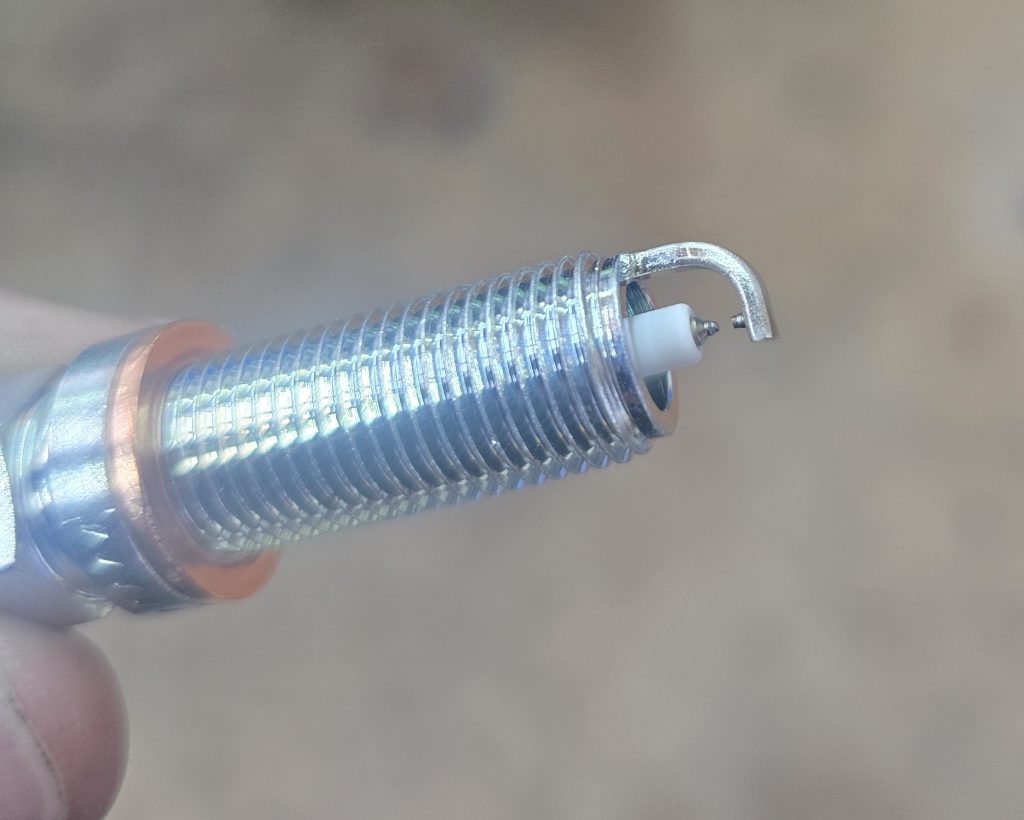
1. Worn or Fouled Spark Plugs: The most frequent culprit. If a spark plug is old or dirty, it can’t create the spark needed to ignite the fuel. This leaves raw gas sitting in your cylinder with nowhere to go. Below is a new spark plug and the very fouled one that it replaced.

2. Faulty Ignition Coils: Modern cars use “coil-on-plug” technology. When a coil fails, the spark plug gets zero power. This causes a “dead miss” in that cylinder, leading to severe engine shaking and a flashing dash light.
3. Clogged or Leaking Fuel Injectors: Your engine needs a precise “mist” of fuel. If an injector is clogged with debris or “stuck open,” the air-fuel balance is destroyed, preventing proper combustion.
4. Loss of Compression: This is a mechanical failure where the cylinder can no longer “seal” the air-fuel mixture. Whether it’s a blown head gasket, worn piston rings, or a burnt valve, if the cylinder can’t build pressure, it can’t fire. This often results in a persistent, heavy misfire that won’t go away with a simple tune-up. Here is a photo from a Chevrolet 5.3L Engine with a bad lifter.

5. Vacuum Leaks: Your engine is essentially a giant air pump. If a rubber hose cracks or an intake gasket fails, “unmetered” air enters the system. This thins out the fuel mixture so much that the spark can’t ignite it, causing a “lean misfire.”
Why a Misfire is a “Catalytic Converter Killer”
When a cylinder misfires, that unburned, raw gasoline doesn’t just disappear. It gets pushed out of the engine and directly into your catalytic converter.
Your converter operates at extremely high temperatures to clean your exhaust. When liquid gasoline hits that white-hot ceramic honeycomb, it ignites instantly. This causes a massive heat spike—often exceeding 1,200°F—which can melt the internal structure of the converter in minutes. Once it melts, it clogs your exhaust, kills your engine power, and results in a replacement cost that often exceeds $2,000.
Beyond the converter, a persistent misfire can also:
- Wash Oil Off Cylinder Walls: Raw gas is a solvent; it can wash away the lubricating oil, leading to permanent piston and cylinder damage (often causing the very loss of compression mentioned in point #4).
- Foul Your Oxygen Sensors: The soot and heat from a misfire can coat your O2 sensors, leading to even more “Check Engine” codes and poor fuel economy.
Don’t Risk It—Get a Precision Diagnostic
If your light is flashing, pull over safely and stop driving. At Priebe’s Auto Clinic, we use advanced waveform analysis and compression testing to see exactly which component is failing. We fix the root cause—saving your engine, your catalytic converter, and your wallet.
📍 4014 N Barnes Ave, Oklahoma City, OK
📞 (405) 523-2172 | PACOKC.COM